
This is the second installment of our review of Chris Newman’s book “Fraud Plunder Treason and Our Treaty“. This time covering the sections on Critical Race theory and the ideological background of Matiu Rata.
Chapter2: The Plunder (page196)
CRITICAL RACE THEORY
By the 1990s, through a process of practice or custom, Critical Theory evolved into Critical Race Theory.
Critical Theory is fashionable among Marxists and leftists because it reframes Marx’s 19th-century conflict ideology of worker vs capitalist in modern terms of “social justice”.
Critical Theorists believe in two social classes, the oppressors and the oppressed. They select the categories of race, sex (take your pick!), religion, nationality, tribal affiliation or any other identity group to establish their identity-conflict model. Then through the institutions of society and the government, they engineer conflict between different identity groups.
So:
Critical Race Theorists stimulate people to identify exclusively with their racial group origins. Then they promote feelings of in-group unity and out-group suspicion towards outside groups, while endorsing the propaganda of diversity and multiculturalism.
Critical Race Theorists invent the racist notion that Maori and Pakeha are opposed identity groups. They find examples of conflict from history and distort them to prove that the race-group members, then and now, are locked in the historical struggle of oppressed and oppressors.
Critical Race Theorists declare that struggle can overcome oppression, to change human society from western Christian society into a socialist multicultural collective and then communist paradise. For them, this is the only means for social progress. Yet they have no historical evidence for the success of their theory.
Cultural Marxism and its bastard child Critical Race Theory focus on conflict and disunity. These ideologies of revolution and rebellion cannot build a society safe for children; therefore, they threaten the survival of humanity, and destabilise established democracies.
Through the lens of Critical Race Theory, a British colonial individual is always biased against and oppressing the poor downtrodden colonised Maori. But this narrative is a lie propagated by those with debased morals. As Minister of Maori Affairs, Rata lived a privileged life, hardly the victim of colonialist oppression. His political actions, fraud and cunning damaged New Zealand society and condemn his memory.
Critical Theory says that all knowledge is biased and ‘objective’ knowledge is distorted by racism, so history is the illusory product of class consciousness. Critical Theorists attack all values and achievements of traditional Western society. They slander the noble qualities of classical literature, promote cultural pessimism, encourage sexual promiscuity, promote death (abortion) rather than life, and actively seek the breakdown of the family.
Critical Theory is the ideology of misery. Its tactic is Political Correctness, a social and intellectual conformity that self-righteously proclaims against the truth. Critical Race Theory teaches that white people are always rotten and people of colour are always good.
Here is an example of the New Zealand media’s Critical Race Theory Treatyist propaganda. Journalist’s broadcast this stuff to the public without making the effort to research the original texts.
In “Newsroom” for 13th May 2022, 7:07 am, there is a headline:
“Commitments to equality in Te Tiriti means co-governance”
By Emily Beausoleil, Janine Hayward, Richard Shaw and Claire Timperley.
This text follows that headline:
“Beliefs that co-governance is ‘unfair’ are based on fundamental misconceptions about Te Tiriti o Waitangi and what a commitment to equality truly means as both democratic principle and obligation.”
They have it all wrong.
Despite the lies and misinformation the media propagates, the truth remains in the original documents. Article The Third of the Treaty of Waitangi states, in James Busby’s draft of 1840,
The people of New Zealand shall be protected by the Queen of England, and the rights and privileges of British subjects will be granted to them.
What do these reporters not understand about the plain English meaning of Te Tiriti? Te Tiriti guarantees maori, who are people of New Zealand, the same equality under British law as her other subjects.
Sir Apirana Ngata and other Maori notables declared, as did Queen Victoria that equality for Maori means equal protection under British Law. Co-governance was never agreed to by the chiefs and tribes who signed Te Tiriti because they wanted to live under British rule, having experienced the failure of their tribal system.
The chiefs did not wish to have two systems; they chose just one. They committed to the rule of British sovereignty. If the above example is anything to go by, then the ‘Newsroom’ reporters typify the spiritual corruption in the soul of New Zealand mainstream media. They are strangers to the truth and intimate with falsehood.
The Iwi corporations and the Crown have the financial and political means to assert their Official Narrative over the people, especially their control over the media, which Jacinda Ardern prostituted with her $55 million bribe in 2021. Their motives are power, money and preserving their social status at our expense.
Note that genuine Critical Thinking is an analytical tool of reason and truth. It has no connection to Marxist Critical Theory, which teaches that the end (revolution and rebellion) justifies the means.
Chapter Two: The Plunder (page 204)
RATA’S BACKGROUND AND SPIRITUALITY
Wikipedia says this about the political career of Member of Parliament Matiu Rata;
In 1979, Rata became dissatisfied with Labour’s Maori policies. After being dropped as chairman of the Labour caucus committee on Maori Affairs, he resigned. He then formed his party, Mana Motuhake (Maori self-determination) and contested the Northern Maori seat several times. Rata led the far north (Muriwhenua) tribes in presenting their Treaty of Waitangi claims to the Waitangi Tribunal in the late 1980s and early 1990s. These ground-breaking claims led to a settlement of Maori fishing claims in 1992. Rata died in a car accident in 1997.
This article suggests that Rata’s political activities laid the foundation for his later business interests as a paid representative for Treaty claimants. He made profit from his fraud.The three apparent sources for Rata’s political thinking are his membership in the Ratana Church, his association with the Trade Union Movement and his involvement with the Labour Party.
Here is a description of Rata from the Dictionary of New Zealand Biography. It contains many clues about his thinking and influences.
Rata was a complex and contradictory man: socialist apostle, conservative radical, labourer turned cabinet minister, patient reformer prone to impulse. Beneath his affable persona lay a simmering radicalism that transformed Māori grievance into action and altered the course of New Zealand’s colonial trajectory.
Rata was born in 1934, ninety-six years after the signing of the Treaty of Waitangi. He became politically aware of the Treaty in his twenties. The Ratana Church influenced him socially and spiritually. Rata’s politics came some 120 years and four generations after the Treaty. His thinking was typical of the Leftist, socialist ideology of the 1970s.
Various commentators have analysed Rata’s interpretation of the Maori situation. He used three models to analyse tangata whenua as a society distinct from other New Zealanders.
- Maori as a class engaged in conflict relationships with the larger white society = classic Marxist-Stalinist position as found in the Trade Union movement.
- Maori as a unique race and culture, distinct from other groups = humanistic, spiritual and religious interpretation (Ratana Church, personal feelings).
- Maori as a group, standing apart from and in conflict with “Pakeha” society = Cultural Marxist, socialist analysis ( Nga Tamatoa ideology).
Rata’s assumption that Maori are a class different from the rest of society is the root of his intellectual miscalculation, and the source of many unexpected consequences.
Of course people of Maori descent are free to choose a distinct lifestyle path. However, Rata, a part maori, was a Minister in a government pledged to One Law for All. When Rata created a statute providing separate race-based privileges for Maori persons, he divided society and violated New Zealand’s constitution.
Maori are known to praise themselves as the most spiritual of people. That is their Holy (tapu) Story promoting their mana as an expression of spirituality. So, you might conclude that Rata’s affiliation with the Ratana Church guided his moral compass to high levels of Christ-like behavior and humility. The Church’s founder Prophet Ratana elevated the Bible and the Treaty together to make their connection obvious. That spiritual stance influenced his political ideas on the ethical and social order. He taught the Ratana Church members to practise a God centred way of life to guide their political thinking.
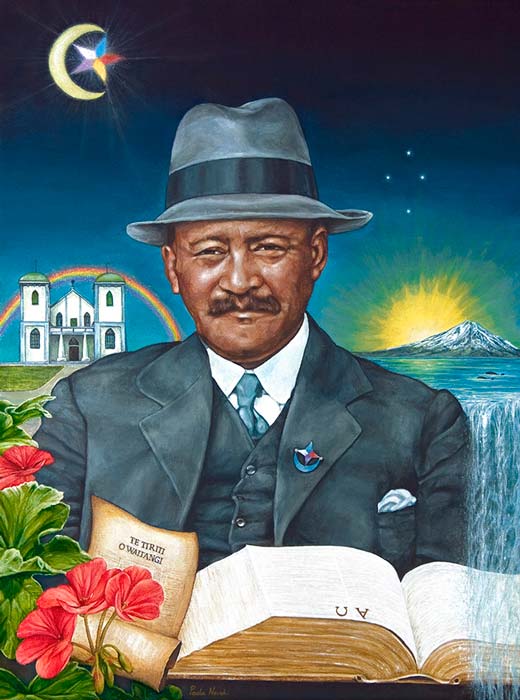
Prophet Ratana, Rata’s spiritual leader, famously declared his mission and ministry, “With the Bible in one hand and the Treaty in the other”. Why and how could he do that? Ratana knew that the basis of the Treaty was British Common Law that flowed back centuries to the Magna Carta and then back through millennia to the Bible. He recognised the Ten Commandments and the absolute sovereignty of Yahweh God as the bedrock for the Treaty and its Christian morality of the Golden Rule.
Study Prophet Ratana’s life, mission and teachings, and you will realise how thoroughly he integrated spirituality with practical projects, community building and political representation. The Ratana Church archives hold many volumes of Ratana’s sermons and speeches. He concluded that the Treaty was a God-given arrangement from the British people to the Maori people, based on Christian principles. Prophet Ratana took his message of self-respect, unity and hard work to every marae in the country and testified to his Christian understanding of the Treaty.
From the 1930s the Ratana Movement built strong links with the Labour Party. Ratana Church politics recognise the Treaty as the charter that protects Maori under the traditions of British Common Law rights. Therefore, Prophet Ratana expected Labour politicians to honour the Christian principle, “Do unto others as you would be done by.” For Ratana, Jesus’ Golden Rule and the Ten Commandments are the guiding principle of Te Tiriti.
Did the Ratana-Labour MP Matiu Rata follow the moral teachings of his Prophet, T.W. Ratana?
The honest answer regarding his political dealings is NO. Rata’s political activities branched into the anti-Christian realms of deceit, misdirection, lies, fraud, and plunder. His Treaty of Waitangi Act 1975 demonstrates many violations of the Bible’s core teachings. Rata’s actions appear to break the following Biblical Commandments:
- Do not bear false witness (fraudulent use of documents and deceit).
- Do not covet the property of others (plunder and greed motivate many Treaty claims).
- Honour your father and your mother (denial of the heritage of mixed-race families as the people of New Zealand and disrespect for the ancestors who signed the Treaty).
Because Rata used Marxist Critical Theory to interpret Maori society and the Treaty, he denied the spiritual authority and Bible-based teachings of his Maori prophet T.W. Ratana.
In politics, Rata surrendered his Christian morality to the conflict ideology of tribalist mana and tapu and the greed of utu and muru. He acted like a Cultural Marxist revolutionary and promoted a course that brought conflict, not healing, to our nation.
Rata was a community-minded Christian idealist. However, his political life as a race-based socialist reveals a streak of devious and manipulative tactics. We can conclude that Rata’s actions in deceiving the Parliament defied and denied the Christian teaching of Prophet Ratana.
 The European New Zealander