
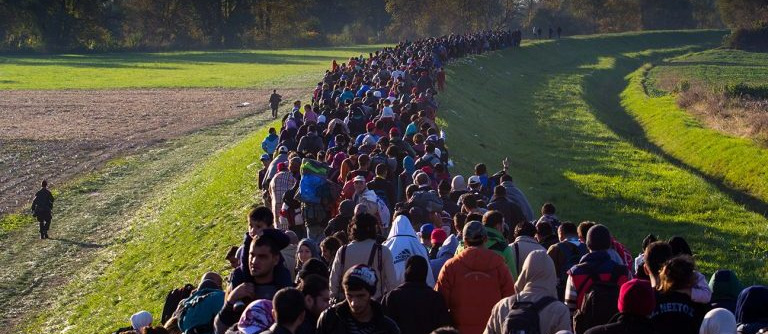
Below is a short excerpt from volume One of Clare Ellis’s three-volume “The Blackening Of Europe”. Essential reading for anyone looking for a comprehensive and scholarly examination of the cultural and demographic decline of the European people. From the back cover…”The Blackening Of Europe is a critical analysis of the historical and ideological origins of the European Union, with special regard to the consequences of these developments for the indigenous Europeans who presently risk becoming demographic and political minorities in their own homelands”.
Available from Amazon
In addition to having their major cities and capitals transformed into global cities dislocated from their nation-state, their blue and white collar jobs out-sourced, their wages and thus jobs undercut by cheaper immigrant labourers, their houses bought by transnational foreigners, their traditions and political culture undermined and altered to accommodate the plurality of immigrants’ ethnic identities and align with cosmopolitan visions of the future, their national identity scrubbed free of any notion of their ethnicity and descent, and their leaders and other European elites making and implementing ground-breaking decisions without democratic consultation, native Europeans are also not afforded special rights to protect, celebrate, and enhance their unique and collective ethnic identities and ways of life. Instead, they are compulsed into political subjection and silenced through various methods of state-enforced coercion such as multiculturalism, political correctness, and punishment of dissent.
British philosopher Roger Scruton explains that the postmodern anti-national Western elite (cosmopolitans) are ‘oikophobes’, or those who are averse to their home:
[T]he oikophobe repudiates national loyalties and defines goals and ideals against the nation, promoting transnational institutions over national governments, accepting and endorsing laws that are imposed from on high by the EU or the UN, and defining his political vision in terms of cosmopolitan values that have been purified of all reference to the particular attachments of a real historical community.
Oikophobes consider themselves as ‘defender[s] of enlightened universalism against local chauvinism’. To better explain this view, one only has to return to Kymlicka’s theory of rights. As mentioned above, Kymlicka grants privileges to minority ethnic immigrant groups in the form of polyethnic rights, and he affords national minority groups group-differentiated rights, which include self-government rights. Both of these groups have special privileges, such as the right to preserve their distinct cultures and ethnic identities, and they also have individual rights. Although pluralistic cosmopolitanism means that different ethnic groups are merely one cultural group among many with no single one being official, and although it holds that all cultures and ethnicities should be preserved and celebrated, Europeans are not included within this ‘enlightened’ cosmopolitical project.
Kymlicka does not grant positive recognition or afford special rights to the majority ethnic group of European nations, i.e. indigenous Europeans, and implies that the identity of the majority is not based on race, ethnicity, heritage or culture, but is defined only in terms of language, multiculturalism, democracy and universal liberal individual rights. In other words, the European societal cultures and ethnic identities are not to be preserved in the way that national minorities are granted special permission to do so: non-European Old-World cultural and ethnic groups are encouraged by various government programs, policies, and acts to embrace, preserve and celebrate their past, identity, history, heritage and culture. European ethnic majorities are only granted individual rights, which, it is assumed, have come to define their societal cultures and identities since 1948 with the introduction of the Universal Declaration of Human Rights, the onset of large-scale non-European immigration in the 1960s, and the implementation and institution of multicultural ideology from the 1970s onwards.
In fact, the ethnic identities of Europeans are stripped altogether from the national identity of their own nations, i.e. national identity now means being multicultural and cosmopolitan. They are told to reject their own historical culture, their heritage, their ethnic identity because of its racist, imperialistic, ethnocentric, and supremacist characteristics, and to fill the vacuum with new liberal and cosmopolitan behaviours, such as a hearty embrace of universal liberal values and ‘enrichment’ by distinctively non-European ethnic cultures. As such, the sense of a collective identity for European ethnic groups has been replaced by a government-instituted ideal-type model, an Enlightenment culture that is neutral to the characteristics that legally define non-European ethnic groups and national minorities, such as culture, history, and race. This neutralization has resulted in diminished European traditions, cultural practices, and heritage, the privileging and trumping of foreigner rights over indigenous European native rights by the granting of special rights and recognition to ethnic minorities, and the violation of the right to self-determination, which includes the right of European majorities to an ethnic identity and the right to preserve, enhance, and celebrate it. This means that ethnic European majorities have undergone a radical transformation in their identity over the last forty-five years, from a European-based ethno-cultural distinctiveness to an ‘enlightened’ universalism not defined by race, ethnicity, culture, or heritage.
 The European New Zealander